ENGINEERING GUIDE · CAMPS & GLAMPING SITES
How to size camp desalination without hidden assumptions.
Turn occupancy phases and real water uses into a transparent production, storage and equipment design basis.
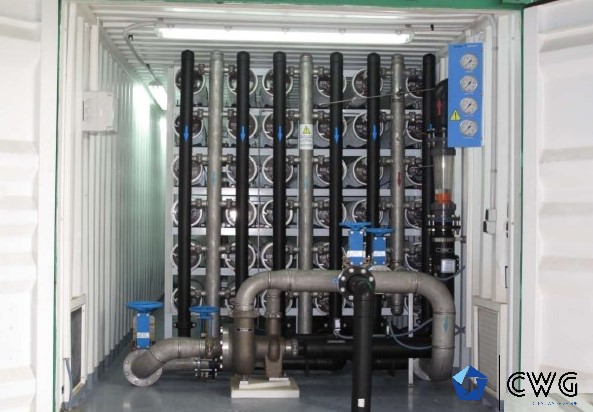
approved treated-water demand per day ÷ realistic production hours × the stated reserve factor
SIX-STEP SIZING METHOD
Build the calculation in the order decisions are made.
Each completed step supplies a verifiable input to the next one.
Define operating phases
List opening, normal, peak and future occupancy as separate design cases.
Build each demand case
Add accommodation, sanitary, catering, laundry, cleaning, staff and other approved uses.
Set production hours
Use realistic RO runtime after flushing, maintenance, source and power limitations.
Define usable storage
Cover hourly peaks and the owner-approved interruption without double-counting reserve.
Verify source water
Use a current analysis and confirm source yield, temperature and seasonal variability.
Select the delivery route
Compare only the DESAL families whose source, output and site format fit the design basis.
DEMAND WORKSHEET
Calculate the water service, not just the population.
Prepare a separate worksheet for every operating phase. Include a stream only when it uses desalinated water, and document the source of each quantity.
| Demand group | Use verified project inputs | Avoid this shortcut |
|---|---|---|
| Accommodation & sanitary | Occupied beds, room standard, fixtures, staff shifts and operating schedule | One generic population multiplier |
| Kitchen & catering | Meals served, preparation, dishwashing, hygiene and kitchen schedule | Assuming every meal has identical demand |
| Laundry & cleaning | Laundry location, equipment duty, housekeeping cycle and washdown | Counting outsourced laundry as on-site demand |
| Staff & shared facilities | Resident and non-resident staff, offices, clinics and common areas | Ignoring day workers and visitors |
| Other treated-water uses | Cooling, landscaping, pools or works only where desalinated quality is required | Sending every site use through RO by default |
| Losses and justified reserve | Measured distribution loss or a clearly stated uncertainty, growth or outage case | Hidden reserve inside multiple line items |
No universal per-person figure: camp standard, climate, fixture selection, catering, laundry, staff pattern and conservation rules materially change demand. Use measured or owner-approved values.
PRODUCTION CALCULATION
Make every variable visible.
The preliminary result is a production target—not a performance guarantee or final model selection.
STORAGE & AVAILABILITY
Storage separates steady production from uneven use.
Do not select a tank from one generic autonomy rule. Define the service interruption, usable volume, peak draw and the output that must remain available during maintenance.
Calculate storage dutyWhat short-term demand peak must the distribution system serve?
02What planned production interruption should storage cover?
03Must water remain available while one RO train or shared component is offline?
04What is the usable—not merely geometric—tank volume?
05How will turnover, level control, disinfection and distribution pressure be managed?
 SOURCE VERIFIED BEFORE EQUIPMENT
SOURCE-WATER GATE
Capacity cannot choose between BWRO and SWRO.
Conductivity or salinity can route the first comparison. Final selection also requires pH, alkalinity, major ions, scaling constituents, turbidity or SDI where relevant, iron, manganese, organics, microbiology, temperature and seasonal source behavior.
VERIFIED PLATFORM ROUTES
Compare only the published boundaries.
Missing technical fields remain unfilled. Final configuration, recovery, energy use, pretreatment and guaranteed performance require engineering approval.
PROJECT CHECKLIST
Send one complete operating case.
A useful concept review connects the calculation, source and installation boundary.
CAMP SIZING FAQ
Common questions before selection.
01How many litres per person should be used for a camp?
SEAMASTER does not publish one universal allowance. Use the owner's design basis, measured consumption or approved fixture and service data for the actual camp standard, climate, catering, laundry and operating rules.
02Should RO capacity equal the camp's highest instantaneous flow?
Usually not. RO can produce steadily into treated-water storage while pumps and the distribution system serve short peaks. Size production from the approved daily demand and realistic operating hours, then verify storage and distribution separately.
03Can different project phases use different RO trains?
A phased multi-train concept can be evaluated, but shared pretreatment, feed pumping, post-treatment, controls, storage and the required output with equipment unavailable must be verified as one architecture.
04When does a camp project move from compact equipment to XL or BOX DESAL?
There is no single capacity-only threshold. Move to project engineering when source conditions, continuous duty, redundancy, pretreatment, controls, site interfaces or the delivery format exceed a straightforward catalog selection.
Camps, glamping & temporary sites
Continue from the calculation into product routing, deployment phases and site interfaces.