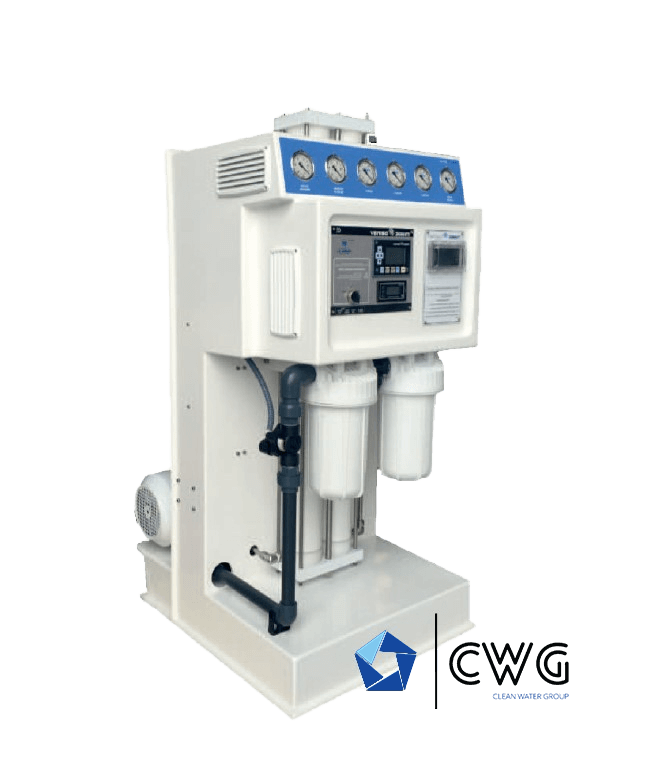
DESAL-BWRO
Defined catalog classes up to 22,000 µS/cm- Pressure duty
- Lower osmotic-pressure duty
- Engineering focus
- Scaling control, ion rejection and recovery
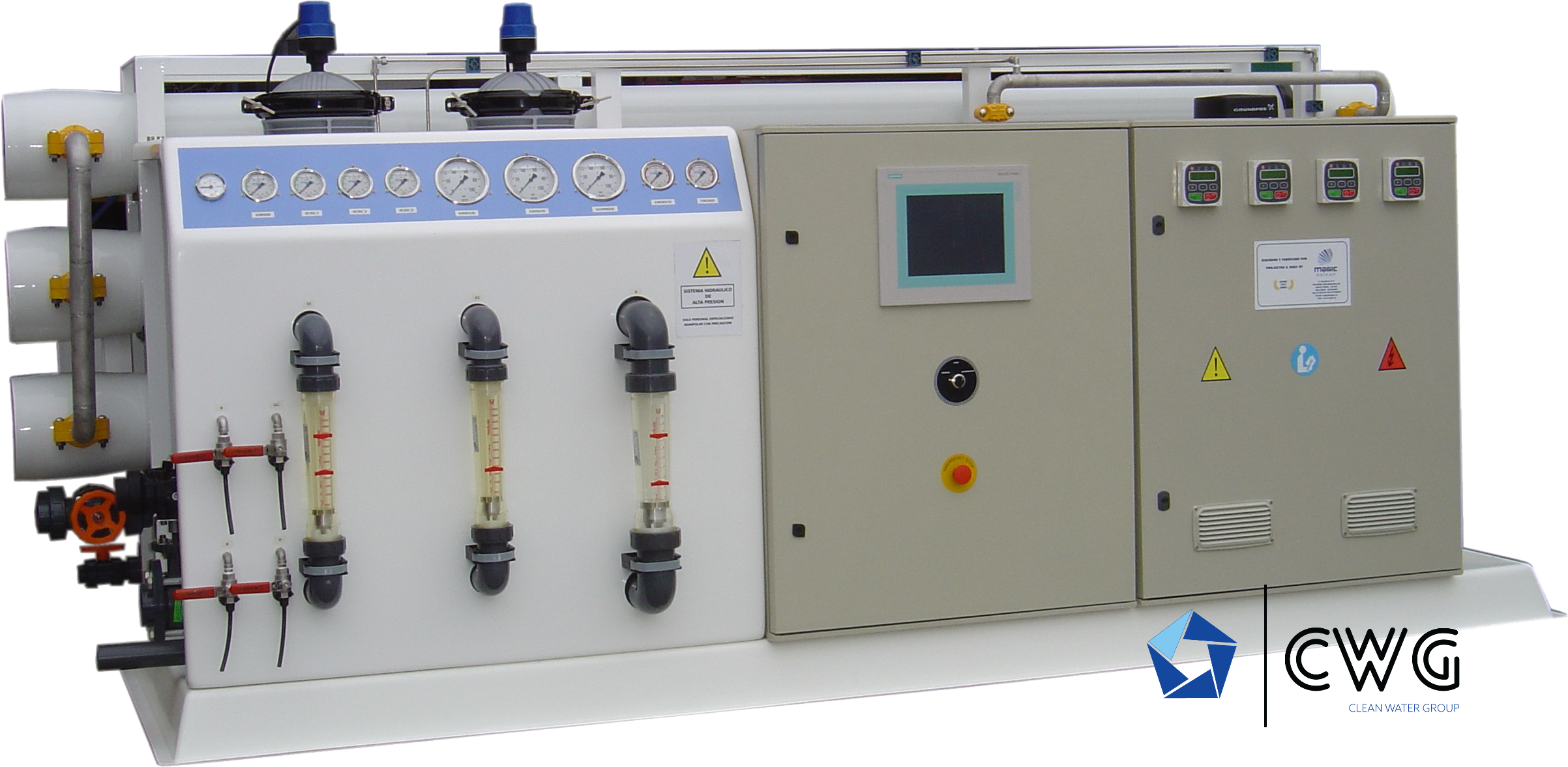
REVERSE OSMOSIS TECHNOLOGY · COMPLETE WATER PATH
SEAMASTER connects water analysis, pretreatment, RO separation, energy, cleaning, post-treatment and automation into one verified desalination system.

The membrane is one barrier inside a complete process. Stable feed conditions, correct recovery, compatible materials, controlled cleaning and final-water conditioning determine whether the plant remains reliable.
SOURCE-WATER ROUTES
Measured source water—not the application name—decides whether the project follows the DESAL-BWRO or DESAL-SWRO path.
COMPLETE RO PROCESS
Every stage has its own design input, measurement and failure mode. The final configuration is developed around their interaction.
Request process review
PRESSURISE · SEPARATE · CONTROL RECOVERYMEMBRANE SEPARATION
Feed pressure must overcome the source's osmotic pressure and system losses. Water passing through the membrane becomes permeate; rejected salts remain in the concentrate stream.
PRETREATMENT RISK MATRIX
The correct pretreatment is selected from the complete analysis and intake behaviour; no single filter train fits every source.
| Risk | What reveals it | Typical engineering response |
|---|---|---|
| Suspended solids | Turbidity, particles, variable intake | Screening, media filtration, cartridge filtration or membrane pretreatment as justified |
| Scaling | Hardness, alkalinity, sulphate, silica, pH and recovery | Recovery control, antiscalant, pH adjustment or softening where required |
| Iron & manganese | Dissolved metals, oxidation state and precipitation | Controlled oxidation, catalytic or media removal, or source-specific treatment |
| Biological fouling | Microbiology, organics, nutrients and warm intake | Intake control, disinfection strategy, filtration and compatible dechlorination |
| Oxidant exposure | Free chlorine or other membrane-incompatible oxidants | Verified neutralisation and residual monitoring before polyamide RO membranes |
Treatment steps are examples of available responses, not an automatic prescription. Compatibility, dose, sequence and control points require project verification.
DETAILED KNOWLEDGE CENTER GUIDESeawater RO pretreatment: intake, barriers and membrane protectionENERGY RECOVERY + CIP
Larger SWRO plants can transfer pressure energy from the concentrate stream back into the process. When fouling or scaling changes normalised performance, an engineered CIP system circulates a compatible cleaning solution through the membrane train.
MONITORING & AUTOMATION
Useful automation protects equipment and produces data that operators can interpret during startup, routine duty, cleaning and fault diagnosis.
Feed, prefilter differential, membrane feed, concentrate and permeate-side pressure where applicable.
Feed, permeate, concentrate, recycle and flushing flows used to confirm recovery and operating balance.
Feed and product conductivity confirm source class, separation behaviour and product-water status.
Temperature changes membrane production and must be included when comparing actual and design performance.
pH, ORP, chlorine or other analyzers are selected around the dosing and water-quality risks.
Permissives, alarms, automatic flushing, tank levels, remote signals and safe shutdown logic protect the plant.
PRODUCT WATER · FINAL DUTYPOST-TREATMENT
Low-mineral RO permeate can be chemically unstable or unsuitable for direct distribution. The final treatment path is selected for drinking water, irrigation, hospitality or industrial process use.
TECHNOLOGY SELECTION GATES
The Finder identifies a catalog starting point. Pretreatment, recovery, materials, energy and final-water quality remain engineering decisions.
TECHNOLOGY FAQ
Both use reverse osmosis, but they are engineered for different osmotic pressure, salinity, materials and operating conditions. DESAL-BWRO is routed by measured brackish-water conductivity class; DESAL-SWRO is configured for verified seawater duty.
Water chemistry, temperature, salinity, recovery, product-water target, operating hours and fouling risk change membrane area, pump duty, pretreatment, materials and controls. Nominal permeate flow alone is not a complete specification.
No. Its value depends on flow, pressure, operating hours, energy cost, maintenance strategy and lifecycle economics. It is most relevant on larger or continuously operated SWRO plants and must be evaluated for the actual duty.
CIP should be triggered from verified, normalised performance trends and the membrane supplier's limits—not from a universal calendar interval. Flow, pressure drop and salt passage must be interpreted together with temperature and operating history.
The need depends on its final use. Drinking-water and distribution duties commonly require stabilisation, remineralisation, pH correction and disinfection. Industrial process water may require a different polishing or quality strategy.
READY TO DEFINE THE PROCESS?
We will identify the DESAL route, pretreatment risks, design inputs and verification steps for the final technical proposal.