01
Day sailing / light crew
- Daily demand
- 180 L/day
- Operating window
- 6 h/day
- Calculated minimum
- 30 L/h
YACHTS & MARINE APPLICATIONS · SEAWATER RO
Convert crew demand, available operating hours, storage and onboard power into the correct DESAL YACHT or DESAL-SWRO PM starting point.
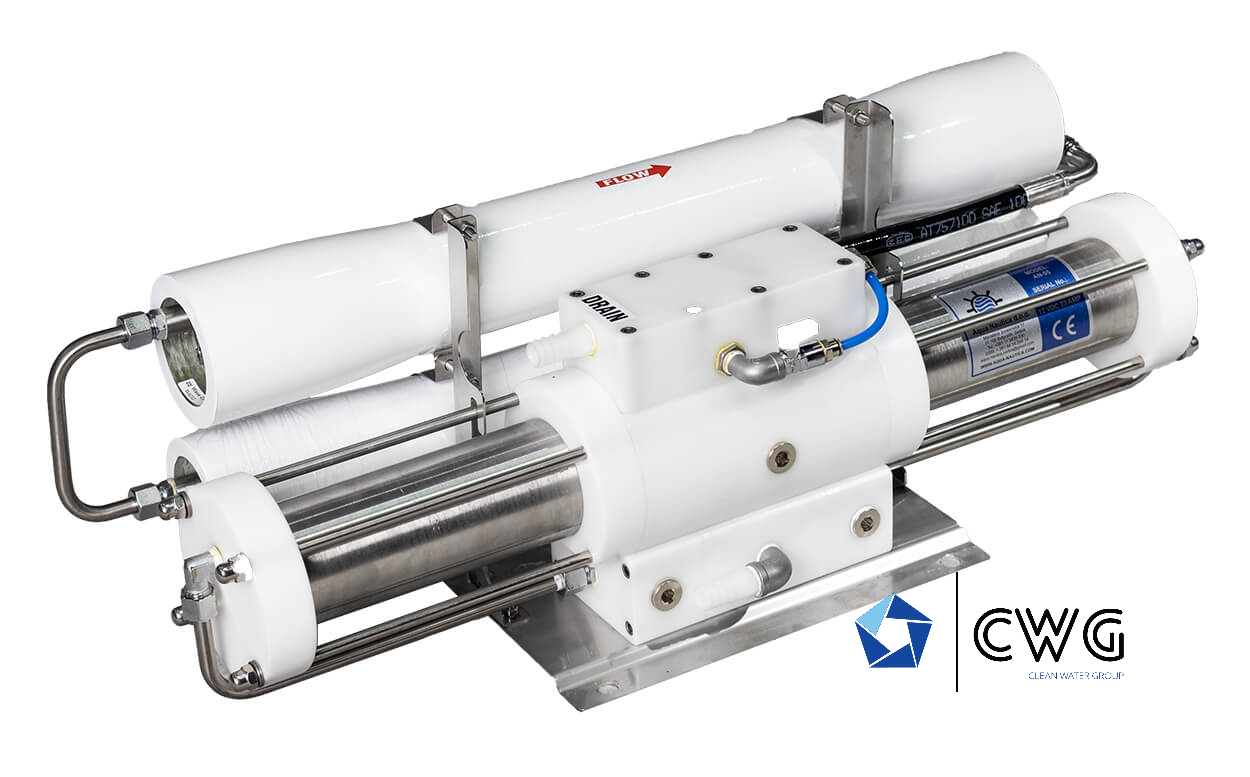
Add realistic freshwater uses, divide the total by the planned daily operating hours, then review reserve, storage, seawater conditions and available power. Yacht length helps describe the installation, but it does not replace a demand calculation.
PRELIMINARY MARINE SIZING
These transparent examples show the first calculation. They are not guaranteed selections and do not include project reserve.
Day sailing / light crew
Regular cruising
Liveaboard / larger crew
Large yacht / vessel
Apply a design reserve only after checking tank volume, voyage profile, acceptable runtime, seawater temperature and conductivity, intake condition and electrical availability.
 MARINE PLATFORM SELECTION
TWO SEAWATER PATHWAYS
For compact onboard production where 12/24 V integration, footprint and normal yacht service access lead the decision.
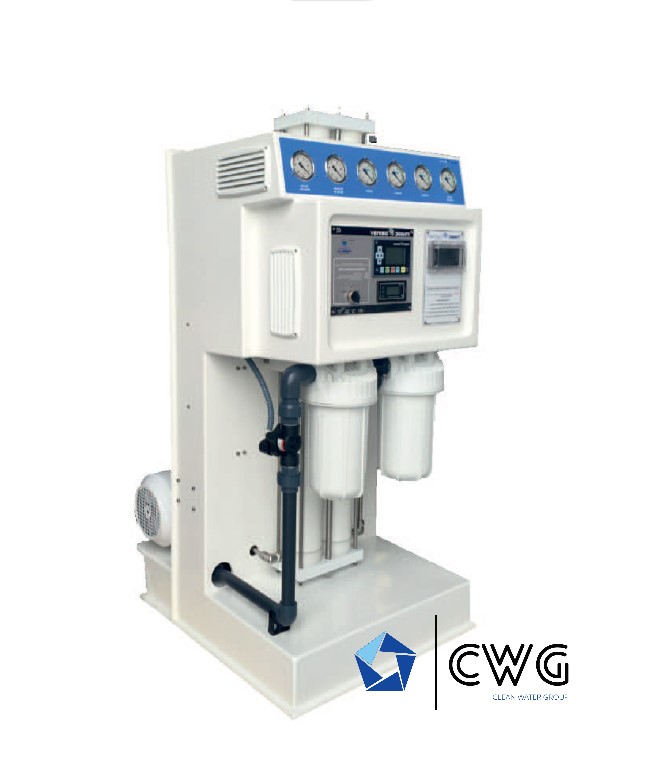
For larger yachts and vessels where required output, longer duty and an engineered electrical arrangement move beyond the compact platform.
*Catalog duty boundary; final output and configuration depend on verified feed water, temperature, pressure, intake condition and the approved technical proposal.
COMPACT YACHT MODEL MAP
ONBOARD INSTALLATION REVIEW
Six interfaces determine whether the selected platform will be serviceable, quiet and dependable onboard.
Locate the seawater intake for stable submergence and clean flow; coordinate an unrestricted, visible brine discharge.
Allow service clearance for strainers and cartridge filters. Intake quality and harbour operation determine the final arrangement.
Verify voltage, cable run, protection, battery or generator duty and realistic concurrent onboard electrical loads.
Reserve access for filters, pump, membrane pressure vessels, preservation and normal inspection—not only the equipment footprint.
Use a suitable foundation, flexible interfaces and separation from accommodation spaces where practical.
Seawater-wetted components, fasteners, piping and installation practices must suit the vessel and marine environment.
MARINE PROJECT WORKFLOW
A short, disciplined review prevents selecting only by headline capacity.
DATA FOR A TECHNICAL REVIEW
Send the best information currently available. Unknown items can be identified during the review.
Send vessel dataEnter the application, daily demand and available operating time. The Finder provides a catalog starting point before the vessel review.
MARINE APPLICATION FAQ
Use the vessel's real consumption records whenever available. Showers, cooking, drinking, deck wash, laundry and guest expectations vary widely, so a generic per-person number can mis-size the system. Add each use, define storage and then apply a design reserve.
No. The calculation gives a minimum nominal output. Colder or more saline water, membrane condition, available power, desired runtime and reserve can justify the next capacity. Final selection follows the vessel review.
DESAL YACHT is the compact 12/24 V route at 30, 60 and 110 L/h. DESAL-SWRO PM extends marine seawater production from 62.5 to 1,041.67 L/h for larger demand and engineered power arrangements. Overlap is resolved by installation, duty cycle and electrical constraints.
The equipment can only be considered after reviewing local water quality and intake risk. Harbour water can carry suspended solids, oil, biological loading and other contamination that may require different pretreatment or make operation inadvisable.
No. Catalog capacities are selection references. Actual output depends on seawater temperature, conductivity, pressure, membrane condition, intake conditions and installation. Guaranteed performance is defined in the approved technical proposal.
READY TO DEFINE YOUR ONBOARD SUPPLY?
We will identify the correct DESAL YACHT or DESAL-SWRO PM starting point and the inputs needed for final engineering.